Category: Uncategorized

Home

I grew up within just a few miles of where my mother, her parents, her grandparents, and I think even her great-grandparents had lived. I lived surrounded by siblings, cousins, aunts and uncles. It was to the point that there was an older man who sat just a few pews ahead of us in church that we called Uncle John. I thought it was just a nickname. I think I was a teenager when I discovered that he really was my great-uncle and I had a whole other crew of cousins that I thought were just neighbors and friends.

My teachers had taught my older brothers and sisters as well as many of my cousins. The lunch lady was my aunt’s mom. I didn’t often know all the connections, but there were always people who knew me, who knew “who I belonged to.”

I left that place nearly 30 years ago. I’ve visited many times since then. It’s a good place to go back to. I’ve been thinking about it lately, realizing how I haven’t had a home since then. I’ve lived in at 10 different towns and more than 20 different houses and met a lot of great people, learned good things, had wonderful experiences, and yet not found a home.

How do we get home? I suppose I could go back to Dacada where I grew up, but would I be home or is that place gone? So much has changed since 1990. I’m not who I was, none of us are. Yet, I need to find a place that is home. Is it right where I am right now? What makes any place where we happen to be become home or not be home?

What would it be to be happy or content, connected to the place where I am? What would it feel like to feel that I am a part of the community and truly belong?

Do other people face this too? Has it become an unrealistic expectation to feel a sense of home? Did I have a special gift that I didn’t realize in the situation in which I grew up?

It seems that today’s blog is simply a series of questions, but it is important for me to write and put my thoughts out into the world. I welcome the insights of others.

peace,

amy
This Year’s Journey, One Month In

We’re already 27 days into the new year. It’s sometimes amazing how quickly time flies. The holidays are gone. The students are back. And now, everyone is hiding away from the frigid temperatures as we dip into the negative double digits. It seemed like a good day to check in on where I am with my New Year’s resolutions.

Here we are with blog post number 4. That seems a reasonable pace toward my fifty for the year. I don’t know that I’ve written much of anything to inspire myself or others, but I’ve written. Maybe the words of inspiration will come.

Thanks to wonders of audio books, I am on track with my book reading too. This exercise is a reminder of how I have come to multitask. Write and listen to a book. Knit and listen to a book. Do housework or office work or drive or whatever else and listen to a book. I question how well I take in all that I listen too. I have found though that it easier to listen to an audio book than a movie. The good books for the month? “The Education of Will” by Patricia McConnell. I’ve loved Dr. McConnell for a number of years. She’s a wonderful dog trainer. The book is an powerful look at who she is as a person and how her relationship with her dog, Will helped her move through some deep pains. It made a lot of sense. “Driving Miss Norma: One Family’s Journey Saying Yes to Living,” another excellent book. It’s a beautiful story of the end of an elderly woman’s life, how it brought her family together and changed their lives and many others.

Getting back to my healthy eating? Well, it’s a lot better without being surrounded by Christmas cookies.

Running? Nope. But, I have been doing more yoga lately and getting out walking quite a bit.

Guitar? Sometimes I think about picking it up. That counts, right?

I am more than half way on finishing a baby blanket for my first knitting project of the year.

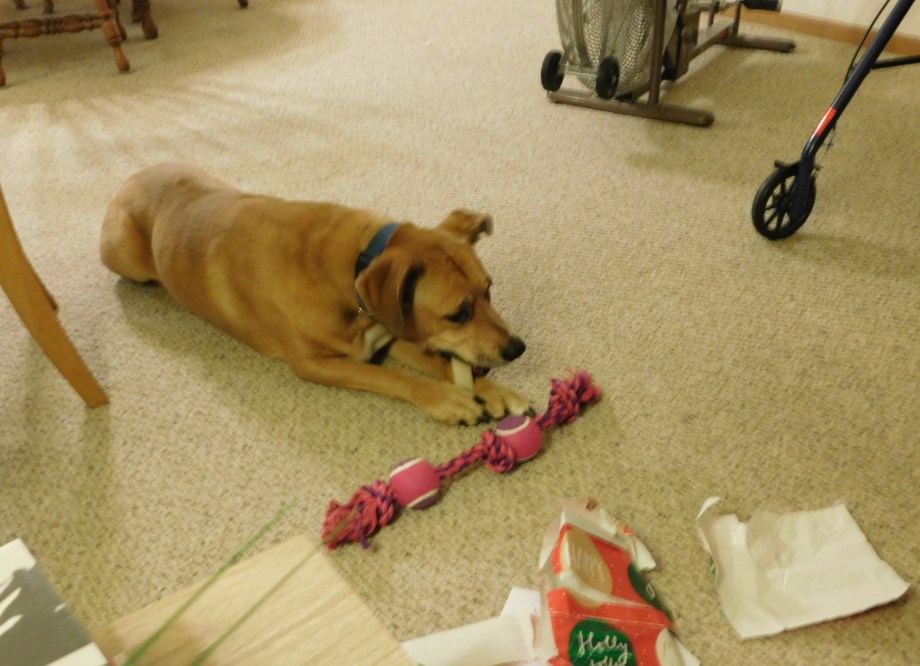
Buddy is doing well with his good canine citizen training which is his first step toward being a therapy dog. It remains questionable whether he will pass the test, but each week gets a little easier. We started the class a few weeks late and his first session was a near total disaster. It was impossible for him to focus with other dogs in the room. The second week he did better, except when practicing stay and come. Then he decided he’d rather go check out the gymnastics equipment on the other end of the gym. And, there was the moment during puppy playtime. Young Buddy is a teenage boy and he was rather smitten with another dog who was several inches taller than him. Suddenly, I had a mess on the floor to clean up! Yep, young Buddy ejaculated across the gym floor. He also pooped in the hallway, but at least we were alone then and I had plenty of poop bags. Last week’s session’s only moment of excitement was coming in to the building. Poor Buddy somehow got his front paw stuck under the heavy entry door for the building. I have never heard a puppy scream like that! Thankfully, there was no significant damage, as confirmed by a classmate who is a vet.

As for cutting my screen time, I think maybe a little, but not all that significantly. Still it seems good. I am happy with the start of the year. Let’s see where it goes.

The Gift of Mustriepen

I was reminded today of a most wonderful and valuable gift I received as a child.  I’ll call it mustriepen.  It was, and remains, the most awful stuff known to the human digestive system. My Uncle Tom is the only person I am aware of on the planet that can make any that is reasonably enjoyable.  For those not familiar with the food, mustriepen is a form of sausage ring made of pork remnants, cabbage, onion, breadcrumbs, blood, and spices.  It came with my people from Luxembourg.

So why call it a wonderful and valuable gift?  I work at university where we have a large population of Native students.  Today in talking with one of those students I got to listen to a story that isn’t uncommon.  The student told me about not getting to spend much time with relatives on the reservation growing up because the reservation was someplace not to be because poverty and addictions.  Staying away kept them safe from such things.  There’s value and truth to that.  But, it also did something else.  That student referred to themselves as white.  It’s only now as a young adult that they are starting to look at who they are in their Indigenous heritage.   We have many students who are blond haired, blued eyed Native Americans.  When they grow up in their cultures and you ask who they are they will proudly say  “I’m from Red Lake” or Leech Lake or wherever.  Many will know how to introduce themselves in their ancestral language, maybe they even speak more.  They know something of who they are.  Now a reservation is simply a place, but it is one place where culture and history stands.  It’s not the only one.  There are many ways to grow up knowing who you are.

The thing is those blond haired, blued eyed Native kids who feel some connection to who they are speak with a sense of strength and grounding that the other kids don’t have.  There are other Native kids like this one who want to know the way home and it’s a hard way to find.

I’m not Native but I grew up with mustriepen and a sense of identity that is unusual for white people today.  My people had lived in Wisconsin since the mid to late 1800’s, but still identified as Luxembourgers.  My dad and some of his generation could still speak the language.  My grandma grew up speaking it.  In the process of becoming white identity is lost.

I am thankful for that gift of mustriepen and I, once again, find myself asking– how do I support and guide these young people who want to know who they are?

WORT- A Story On What Takes To Handle Crisis in Community Organizations

As someone who’s worked many years both professionally and as a volunteer in nonprofits and leadership development, I need to give a shout out to WORT 89.9fm Community Radio in Madison, Wisconsin for really having the essentials together.

I’m not saying that WORT is perfect.  I served on the board for several years when I lived in Madison and I can assure you that they are far from it, but they’ve got the key components and that became really clear recently when they faced a major incident at the station.

WORT is a community led, listener sponsored radio station in progressive Madison that went on the air in 1975 and has been riding the waves of operating in a community oriented space ever since.  In the early morning hours of Sunday, August 5th some of the pain and fear that’s all too common in our reality today walked into the station.  Someone came into the station and fired shots.  A DJ was injured.  Thankfully, the injury wasn’t serious and they were released from the hospital within a few hours.

Here’s where I become amazed.

The shooting happened in the early hours of Sunday morning, a time when the station would just have volunteers in the building and probably no paid staff.

  • The volunteers on air were able to respond to the shooter in a way that minimized harm.
  • Volunteers knew how to reach the board chair.  He was contacted and spoke effectively on behalf of the station with police and media.
  • The news department had a message out the WORT community telling them what had happened within a few hours and cutting off the main flow of the rumor mill.
  • WORT volunteers and listeners immediately stepped up with messages of support, offers of help, and donations.

I was thinking about this yesterday because of another board that I serve on.  It’s a struggling organization and I agreed to serve on the board because I believe they can be better.  Right now if there was an incident like the one WORT faced, I’m not sure what would happen.

We all hope none of our organizations ever have to face such moments of terror, but there is a lot to learn from WORT even for our every day operations.

  • Do your volunteers know who the person or people are who speak on behalf of the organization and how to reach them?
  • Do they know what to do in case of emergency?
  • Do you have a communications plan?
  • Do your volunteers and supporters feel that sense of connection to your organization that they’ll step up in a time of need?

WORT has had many ups and downs over its more than 40 years of operation.  It’s taken a lot of work to get to the point that they could get stronger from disaster rather than weaker.  Now is the time to work on these issues in your organization.  Don’t wait for the emergency to happen.

Food for Thought From the Garden

Roughly 45lbs of food, that’s what came out of the garden that I share with my friend David yesterday.  I will admit there was apple tree involved and apples are heavy.  Still, it’s an impressive haul from just an average small town back yard.  I haven’t been consistent about weighing the food that I harvest, but this makes me wonder.  How much have I gotten from the garden this year and how much is there?  Is it 200lbs, 500, a 1,000?

In any case, it the experience is worth its weight in gold.  The dog and I walk the few blocks over to David’s house where I unleash Bella to let her lay in the shade while I weed and discover the bounty.  Depending on the amount to harvest and the number of mosquitoes we may be there a few minutes or a few hours.  If David is home we enjoy some visiting while we’re there.

Yesterday I found a butternut squash where I thought I’d accidentally killed off the vine.  It was great find.  Earlier this summer I was awed by lettuce that kept producing tasty leaves even in the hottest days of July.  I can’t say that I ever find this kind of joy and wonder in the aisles of the supermarkets looking at the harvests trucked in from 500 miles away.

I spent most of my day yesterday in my kitchen watching movies on my computer while making spaghetti sauce for winter, freezing carrots, drying apples, baking granola, and making a bit of cucumber salad.  I still have quite a bit of that 45 lbs of produce to preserve so I’ll be back at it tonight. But, it brings me such simple joy.

I spend the time engulfed the sweet and savory smells of my creations eyeing the wonders that I had the good fortune to harvest, being awed just that they’re real.  I get to bathe in the memories other times and other kitchens with friends and family, so much laughter and so much love.

I think a lot about convenience.  I think about how we were sold the idea of processed foods in the 1950’s.  We were told they were convenient, time savers.  Yes, I spent a wonderful day yesterday enjoying the food I grew and harvested.  I got to spend time with my dog and cats, just being at home and being creative.  I don’t know a better use of that time.  I am glad I didn’t give it away to something else less valuable.  I am confident too, that there will be times this winter that I will be glad of my pre-prepared sauces and soups and other wonders that I can heat in just a few minutes for supper that were made in my kitchen and not a science lab with food not food-like substances.

An All White Town

I grew up in rural Wisconsin in the 1970’s and 80’s in an all white town, except that it wasn’t, all white that is.

I don’t know exactly when I realized that little bit of information. I just know that even today I hear about rural communities being “all white” and I wonder.  I know that was the story of the area that I grew up.  That’s how we, at least we who identified as white, spoke.  “Those people” whoever “those people” were lived somewhere else, maybe in Chicago or Milwaukee or up north on the reservations, but certainly not in our area.

While I was busy living in that White Town fantasy world, some of my friends were living the reality of being bi-racial, Latino, or Asian in a community that didn’t, and probably still doesn’t really recognize them for who they are.  Instead, it asks that they pretend to be White or better yet, just be invisible or don’t be.

Well, these days I hang my hat in west central Minnesota.  I’m still in a small town and I work with small towns around the state.  Our rural communities are changing.  The White population is slowly shrinking and the population of people of Color is growing.  It’s going to continue that way into the foreseeable future.  It wasn’t ok for us to expect people of Color to pretend to be White or to try to be invisible or to just not be thirty years ago.  It’s absolutely unacceptable today.

Do we want rural communities to survive?  If we do, then we need to take a look at ourselves and ask some questions.

  • Am I seeing everyone who lives here for who they are or am I asking them to reflect me?
  • What am I doing to honor the experience and gifts that People of Color bring to the table?
  • How am I perpetuating racist systems and how am I tearing them down in my every day?
  • Who do I welcome and how?
  • What do I want my community to look like in twenty years? What will it take to get there?

I am sure there are many more questions to consider, but these give us a starting point.  The key thing is that the fantasy White Town has always been a nightmare for some and is becoming a nightmare for all.  If we want the nightmare to end, we need to look racism in the eye and tell it no more.