Category: community

No One Wants An Abortion

No one wants to have an abortion. Let’s just start there. It’s not something a woman does because she wants to have a surgery that will leave her with memories and questions for the rest of her life. She doesn’t want to always be able to look back and ask herself would it have been a boy or girl? Who would it have been? What would she have been like as a mother to that being?

The right to have an abortion is perhaps one of the greatest signs of motherhood. Afterall, the mother’s role is to do the best possible for the being in her womb. Sometimes the best and the hardest is to protect that being from a life of pain and want. Sometimes the best and the hardest is to protect them from abuse or from severe health conditions that would make living impossible. Sometimes the best and the hardest is to protect them from entering a world in which they will be treated with hatred by the people who are supposed to love them. There are so many reasons that a woman may choose to have an abortion. None are so simple as she wants one. All are about doing the best that she can for the being that grows inside her and for herself as well. The mother’s relationship with herself, with the world, and with her understanding of God will all change, but she will have done what she needed to do to care for herself and for the being she carried.

How can the court be so cruel to these women and unborn beings? Without legal abortions these women will not be able to save the beings in their wombs from lives of ongoing pain. If they try they will risk their own lives. What will we have won to lose both the mother and the fetus? Maybe it is these women who would risk their lives for the well-being of someone who they will never know who should be in charge instead of these judges who are willing to force them to put their lives at risk.

What Happened Next? Looking at the History of Underrepresented Peoples

I was watching a documentary on PBS last night about the life of Helen Keller. It was an interesting show that focused primarily on her adult years rather than the childhood picture that so many of us were introduced to as children. It made me wonder about how often we cheat ourselves by contenting ourselves with stories of history that are meant for children and that usually are missing major pieces that really make the story. I wonder how often we cheat the children in our lives by minimizing their education with these simple stories like that of the little deaf and blind girl and fail to tell them of the woman who was a prominent socialist, a skilled writer, an actor, public speaker, ambassador for US, and so much more?

Clearly, stories designed for children whether written or video or some other form are often less complex than those created for adults. But, how do we take that first story and make into a series? When we look at something like “The Miracle Worker” it seems like the story ends with the miracle of Helen learning to communicate, but in reality that’s only the beginning. We do much the same thing when we talk about many other figures in history, particularly those from historically underrepresented groups. Rosa Parks is a great example. We largely get the story that this individual woman was tired, sat down, and refused to give up her seat on the bus. Not only is that historically inaccurate, but it’s incomplete. Mrs. Parks was a trained community activist who had a history in the Civil Rights Movement. She was part of a much larger strategy to integrate the busses in Montgomery. She also remained active working for social justice through the Civil Rights Movement, Black Power Movement, as a staff person to US Representative John Conyers, and working to support political prisoners in the US among other issues until her death in 2005.

People like Ms. Keller and Mrs. Parks are so much more than what we often give them credit for. By failing to recognize the breadth of their contributions and those of others like them we fail to fully support and encourage the next generations of those who share pieces of their realities, whether those be young women, people with disabilities, people of color, Indigenous peoples, or others. Reading the children’s books and watching kids movies about these historical figures is great, by all means do it! Don’t forget the next step though. Dig a little deeper. Ask “what happened next?”

Thinking About an Old Mentor

I met him 23 years ago in a McDonald’s in East Tennessee. I was a twenty-something community organizer embarking on my first “real job” after college. I’d only just arrived in Tennessee from Wisconsin a few weeks before full of brilliant ideas and energy, ready to save the world. He was a middle-aged factory worker who’d grown up and lived his whole life in Appalachia. My young and oh so wise self was sure I’d have so much to teach him from my infinite stores of knowledge. It didn’t take long for me to see just how wrong I was.

My co-organizer Gil and I had just arrived. Gil would be introducing me and starting to hand over the work of coordinating the strip-mining issues committee. We were meeting Landon Medley, the committee chair, at McDonald’s that day. Gil and I had spent a lot of time discussing the Fall Creek Falls campaign, a major campaign to protect more than 60,000 acres of land surround the tallest waterfall east of the Rocky Mountains from strip-mining. He’d told me a great deal about the strategy so far and where it was headed as well as about each of the committee members and allies involved. He told me quite a bit about Landon and who he was. I don’t remember if he ever mentioned the crutches though. I remember not quite knowing what to do when this short middle-aged man using Loftstrand crutches walked toward us and Gil greeted him. Should I help him? How could I assist?

It was only a moment. Then as quickly as those crutches were set aside, I began to learn. Landon was one of the children of the 1940’s in Appalachia who survived polio. While the illness left him with a disability that impacted his life and health, it never stopped him and maybe even made him stronger. He had a love for his Appalachian home that ran deep in his soul. I still have a painting on my bookshelf that he made for me of those beautiful mountains. There is no place on earth like it. He was a gifted historian and author. He was also a great leader of the fight to protect his mountain homeland from multinational mining corporations and others who have sought to destroy it in so many ways. It was a gift to call him my friend and mentor.

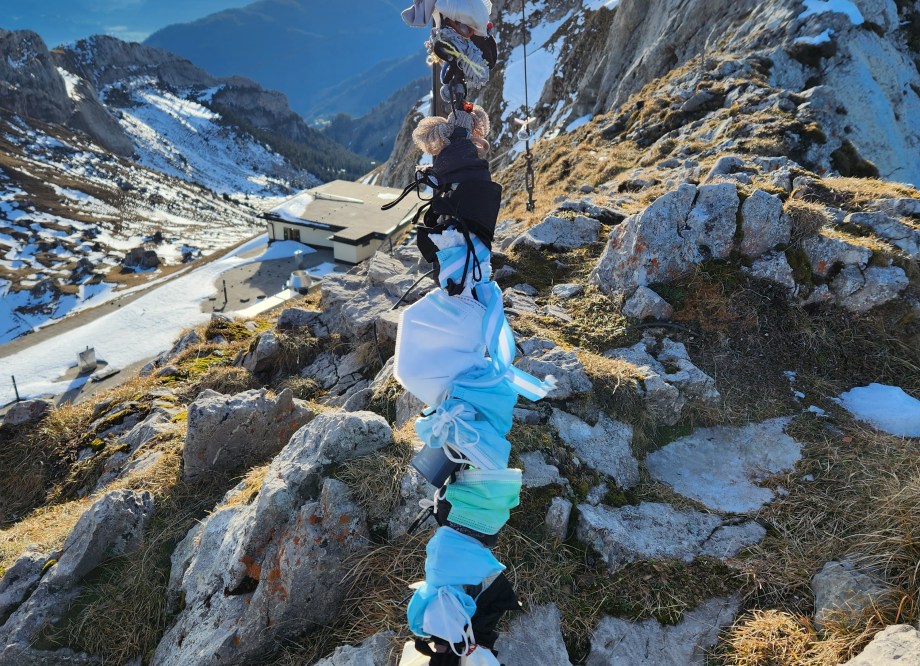
Today I learned that because he’d had polio as a child he wasn’t able to receive the COVID vaccine. A little boy who won the fight against one the most devastating diseases of the 20th century thanks to medical advances and much struggle, lost the fight against COVID. It hurts to think that he didn’t have to lose this struggle. He lost because of all the people who’ve opted not to get vaccinated, who’ve chosen not to wear masks, who’ve taken unnecessary risks, thinking that their actions only impact themselves. We aren’t separate beings. We are connected. I ask that each person who reads this act not only for yourself, but for the love of others. I wish you all wellness and joy. Take good care.

Riding the Bus in Madison

I gave up my driver’s license two months ago after I had a seizure on my way home from the grocery store. Since then I’ve been using my old license just for identification until getting settled in my new apartment. I moved at the beginning of the month and today I was finally able to head to the DMV to replace the no longer valid license with a new state ID card.

The exercise of getting a state ID was a good reminder of what I have to be thankful for and a great look at how class and ability impact our lives. My seizure in August meant leaving the small town where I was living to return to Madison. Madison has public transportation. It is, at least in theory, an accessible community in which to live.

My trip to the DMV today was via the bus. Taking a cab could have been an option, but it cost more than I cared to spend for a trip to just get a new ID. It began by needing to schedule my day according to when the best route options were available. Then waiting at the stop to ride the half hour on what would have been a ten minute car trip. Along the trip I read the information about how the busses are being cleaned during COVID and the rules riders need to follow and pondered how much each ride increased my risk of disease.

Thanks to being given the wrong form and a mildly confused elderly man in the line front of me, my visit to the DMV took a bit longer than expected. That meant walking out the door just as the ideal bus to take home pulled away. So, I walked about a half mile to catch another bus. My trip that would have taken probably about an hour or maybe less if I were driving took about three hours on the bus.

I don’t ride the bus often, but when I do it is clear who the busses serve. The vast majority of people I see are BIPOC, low income, homeless, students, and people with mental health issues. If my experience today is typical and it takes three times as long to complete a task via bus or even just twice as long as it does for someone using a car, I wonder how we can expect people to get ahead? How does someone win when a bus that is a few minutes late makes you late for your transfer or your job? How do you hold control in your own life when you are living by the bus schedule and others set their own times?

The busses are a place where social and environmental justice come together. There are many who care about climate change and clean water and clean air and all those things. Many who know that public transportation is environmentally more sound than private cars, but yet they don’t ride. Why not? I suspect a few things, first there is that issue of timeliness, being able to get to the places they want to go, and get tasks done and secondly there is the issue of the other riders of the bus– those who are BIPC, low income, homeless, and those with mental health issues. Could it be possible if bus service were improved and these individuals were able to begin to bridge the gap, able to access the services they need, get to work, school, and able to run their errands in a more timely way that the busses would become a more welcoming service for all while also making life just a bit better for those who need it? Sometimes we just need to draw the connections. Make it possible for folks to do the work they need to do and life gets better for us all.

Just some ponderings from today’s and a couple of other recent trips on Madison’s busses. What do others think?

What is an Activist

When I began Sustainable Life in Action back in 2013 the Grassroots Leadership College had only been closed for a year and I was trying to find enough work to keep my rent paid and figuring out how to keep doing community organizing. My dreams were of starting a new Grassroots Leadership College maybe statewide or maybe in northern Wisconsin along the shores of Lake Superior. It wasn’t too much later that I left Madison. Life didn’t take me to northern Wisconsin, but to Minnesota.

In those days, for me, being an activist still meant organizing people, coordinating trainings, taking part in protests, speaking at rallies, being a force, and fighting out loud in a non-violent yet intense way. While my work was for a better world most of my actions still landed in the realm of working against the evils. I loved my work. I loved getting to know people, making connections, supporting others in achieving their dreams, creating positive social change. We did create change. Every time we people connected and came to know each other, to see each other as valuable human beings we were creating change, not to mention all the battles won.

Despite my love for my life work I was burning out. That’s why I started Sustainable Life in Action. It was a tool to encourage my own self care as well as to support others in caring for themselves. It has been a helpful tool for me. I hope it has been for others as well.

My journey as an activist has reached a new stage. It is an interesting one for me. After seven years in Minnesota and one in Poynette, Wisconsin, I have returned to Madison where Sustainable Life in Action began. When I left this place I was deeply involved in the activist scene. My name was known for work I’d done, nine years running the Grassroots Leadership College, coordinating the non-violence trainings for the capitol take-over during the Walker administration, Green Party stuff, Labor Radio and board leadership at WORT 89.9fm, and more. Now, I am coming back in quietly to a place where there are many new leaders and much of the old guard seems to have disappeared or maybe just is quiet in these times of COVID. It is coming back to a place where I’ve never been before.

It’s good to stand and watch this new place as I too am in a new place internally. After looking for jobs in the nonprofit realm and at the university and colleges to no avail, feeling my stomach churn a bit as I considered roles in organizing again, I decided to go back to another of my earlier careers. I accepted a position as an infant/toddler teacher in a large local child care. I’ve been intrigued by the reaction of old friends who seem to believe that going into teaching early childhood is leaving the world of activism. These people tell me how I’ve “done my time” and that it’s okay for me to do something else.

How can there be anything that is more about social justice than caring for our children? Being an activist isn’t all about holding up signs and shouting slogans. Being an activist is about how we live our lives. At this phase of my being, much of my time will be dedicated to holding the little ones and showing them love. I’ve also chosen to commit my time to being creative, telling my stories, and playing with art. All these things are important. I haven’t done my time, none of us has. We all have a duty to care for this place and for each other each day for the remainder of our time. How we do it is up to us.

Take good care of yourselves. That’s where it all begins.